.png)
Open Access
1 April 2026
Original Research
In Vivo Magnetic Resonance Spectroscopy (MRS): A critical mini-review of MRS limitations and multiscale interpretation
Angelos Kalafatas
Abstract
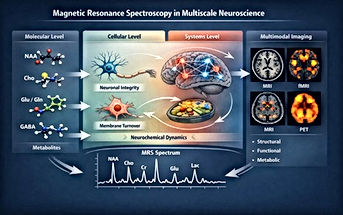
Magnetic Resonance Spectroscopy (MRS) provides a non-invasive means of interrogating in vivo biochemical processes, extending magnetic resonance methodologies beyond structural and hemodynamic imaging into the domain of cellular metabolism. Unlike conventional Magnetic Resonance Imaging (MRI), which primarily captures anatomical organization and indirect functional signals, MRS resolves metabolite-specific spectral features, enabling the quantification of neurochemical states within intact tissue. Advances over recent decades (including ultra-high-field systems, improvements in radiofrequency coil design, optimized pulse sequences, and increasingly sophisticated spectral modeling) have significantly enhanced signal fidelity and metabolite resolution. These developments have expanded the applicability of MRS across neurology, psychiatry, oncology, and metabolic research. However, such progress has also exposed fundamental interpretative challenges, particularly regarding spectral overlap, macromolecular contributions, and the limited specificity with which individual metabolites can be mapped onto discrete biological processes. Accordingly, the utility of MRS cannot be understood solely in terms of improved detection sensitivity or expanded clinical deployment. Rather, its interpretative power depends on how spectroscopic signals are situated within a broader multiscale framework linking molecular metabolism, cellular function, and systems-level dynamics. This mini-review, therefore, moves beyond purely technical accounts by critically examining the assumptions underlying metabolite attribution and emphasizing the necessity of multimodal integration. By synthesizing physical principles, methodological constraints, and neurobiological interpretation, this work advances a more constrained and context-sensitive framework for MRS analysis. Emerging developments (including multimodal imaging integration and machine-learning-assisted spectral decomposition) are evaluated in this light, with particular attention to their implications for multiscale neuroscience and multiscale brain imaging.
Keywords
Magnetic resonance spectroscopy, neurochemistry, metabolomics; multiscale brain imaging, multiscale neuroscience, spectral analysis.
How to Cite this Article
Angelos Kalafatas (2026). In vivo magnetic resonance spectroscopy (MRS): A critical mini-review of MRS limitations and multiscale interpretation. Journal of Multiscale Neuroscience 5(1):12-19. DOI: https://doi.org/10.56280/1739853142
Author Affiliation
Department of Chemistry, Democritus University of Thrace, Kavala, Greece, St. Lukas Region, 65404, Kavala, Greece
Received Date: 20 March 2026
Accepted Date: 26 March 2026
Online Published: 30 March 2026
Conflict of Interest
The author declares no conflict of interest
Copyright: © 2026 The Author(s). Published by Neural Press. This is an open access article distributed under the terms and conditions of the CC BY 4.0 license.
Disclaimer
All claims expressed in this article are solely those of the authors and do not necessarily represent those of their affiliated organizations, or those of the publisher, Neural Press™ or the editors, and the reviewers. Any product that may be evaluated in this article, or claim that made by its manufacturer, is not guaranteed or endorsed by the publisher.
References:
Alger, J.R. (1991) Quantitative proton spectroscopy and spectroscopic imaging of the brain. Journal of Magnetic Resonance Imaging 1, 363–373.
Arnold, D.L. (2003) MS metabolism. Journal of the Neurological Sciences 206, 37–42.
Barker, P.B. (1998) N-acetyl aspartate—a neuronal marker? Annals of Neurology 44, 481–482.
Baslow, M.H. (2002) N-acetylaspartate function. Neurochemistry International 41, 295–300.
Bhagwagar, Z., Wylezinska, M., Jezzard, P., Evans, J., Ashworth, F. et al. (2007) GABA abnormalities in depression. American Journal of Psychiatry 164, 1032–1037.
Bogner, W. (2012) MRSI advances. NMR in Biomedicine 25, 873–885.
Bottomley, P.A. (1982) Selective volume method for localized NMR spectroscopy. Journal of Magnetic Resonance 50, 335–338.
Butterworth, R.F. (2002) Hepatic encephalopathy. Metabolic Brain Disease 17, 221–227.
Castillo, M. (1998) Brain tumors: Magnetic resonance spectroscopy. American Journal of Neuroradiology 19, 1079–1085.
Cendes, F., Andermann, F., Dubeau, F., Matthews, P.M. and Arnold, D.L. (1995) Epilepsy spectroscopy. Annals of Neurology 37, 201–207.
Choi, C., Coupland, N.J., Bhardwaj, P.P., Malykhin, N., Gheorghiu, D. and Allen, P.S. (2005) GABA editing techniques. Magnetic Resonance in Medicine 54, 272–279.
Davie, C.A., Barker, G.J., Thompson, A.J., Tofts, P.S., McDonald, W.I. and Miller, D.H. (1996) NAA in multiple sclerosis. Neurology 47, 1536–1540.